
LOCATION
Volcano-In Hotel of Arrivals
Baiyinkulun Steppe&Volcano Tourism Resort, Xilinhot, Inner Mongolia, China
STATUS
Completed
YEAR
2024-2025
SIZE
5,540sqm

INTRODUCTION
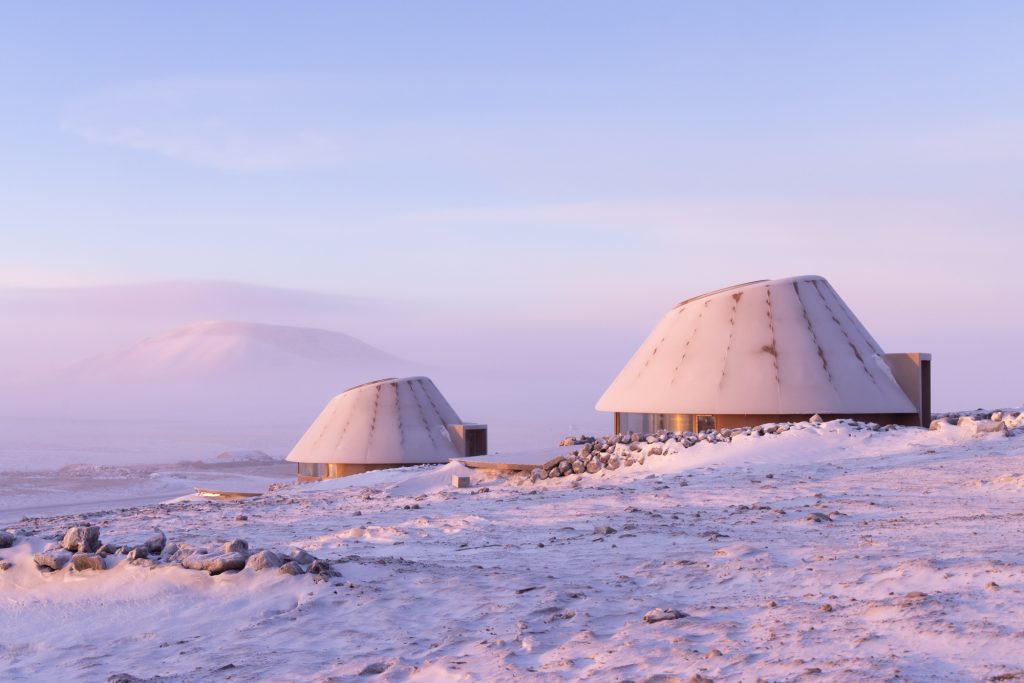
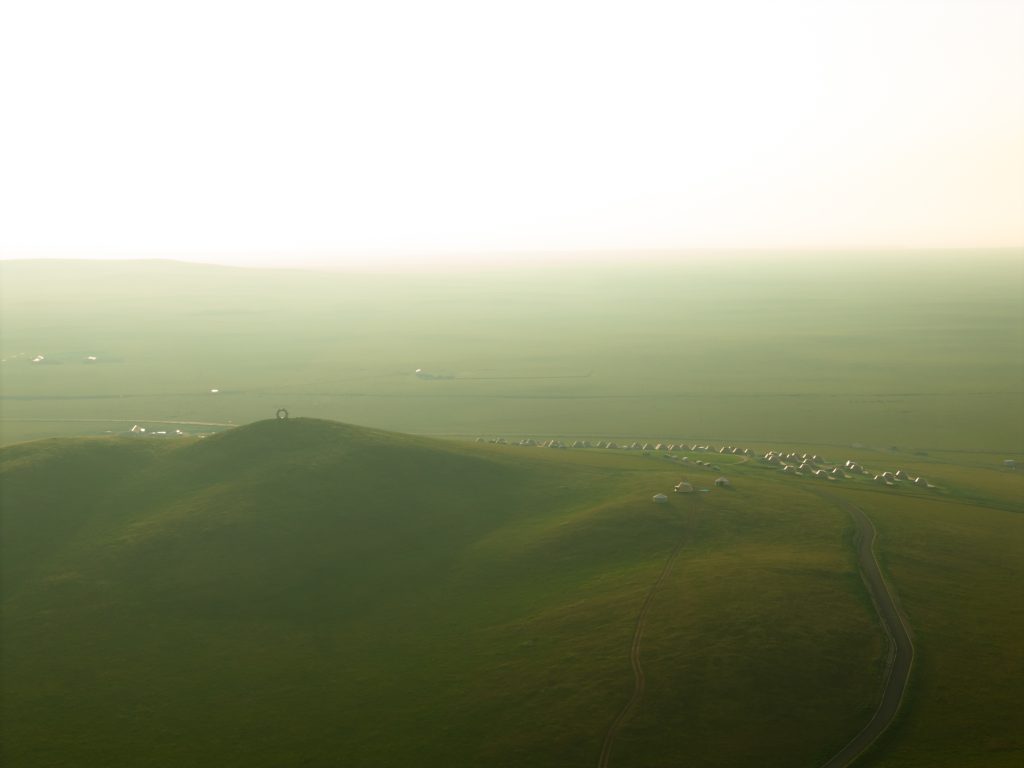
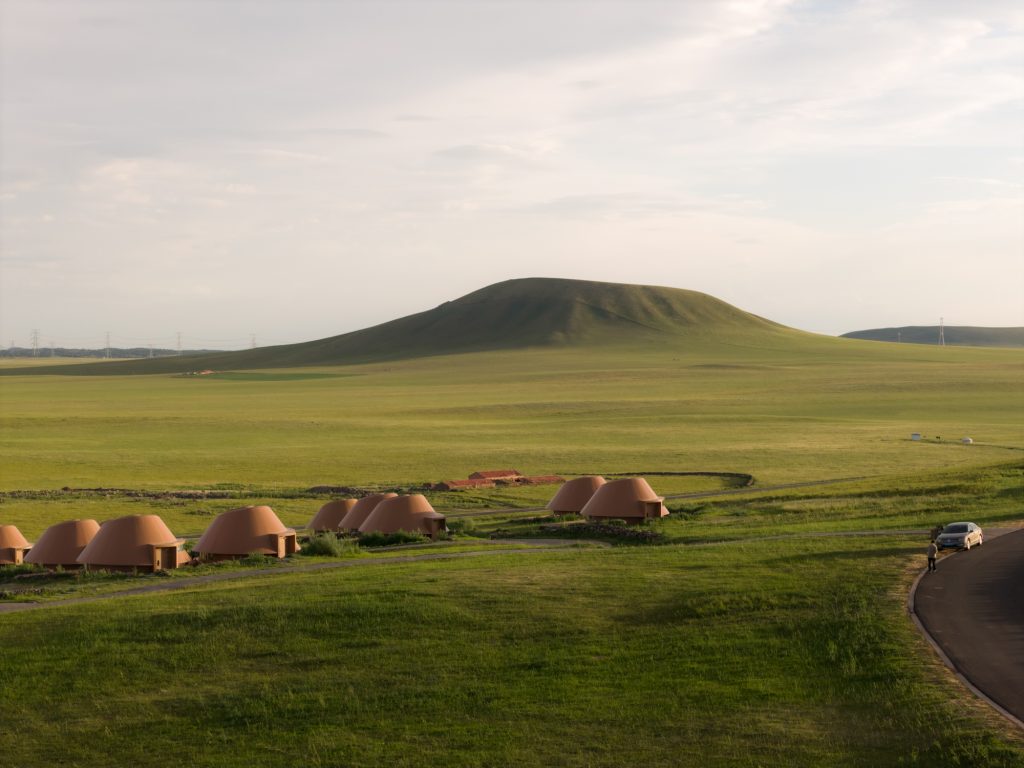
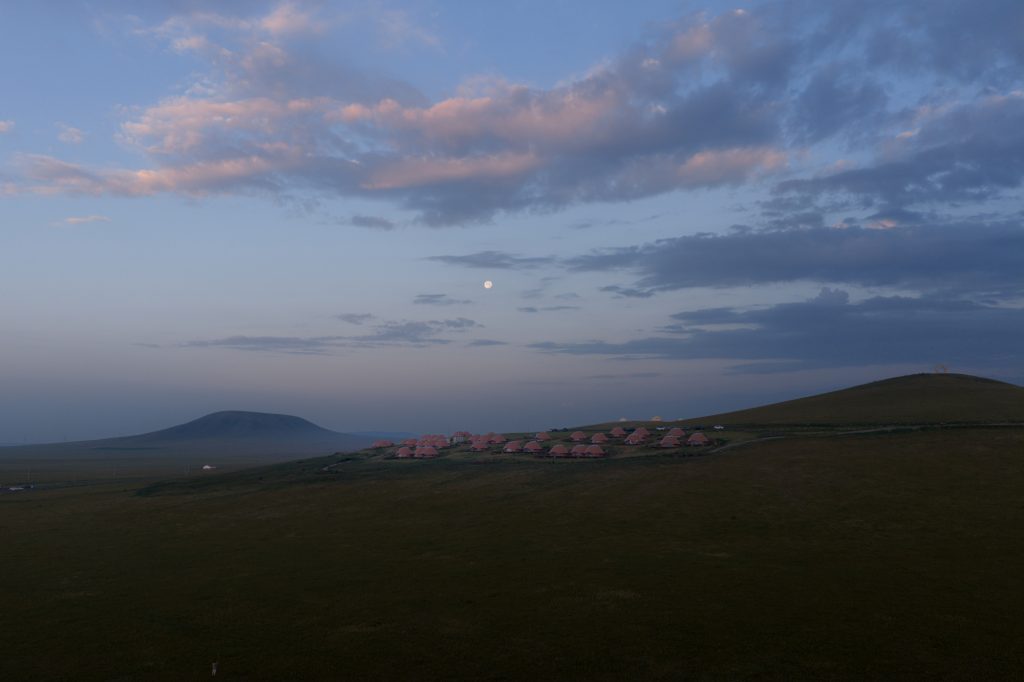
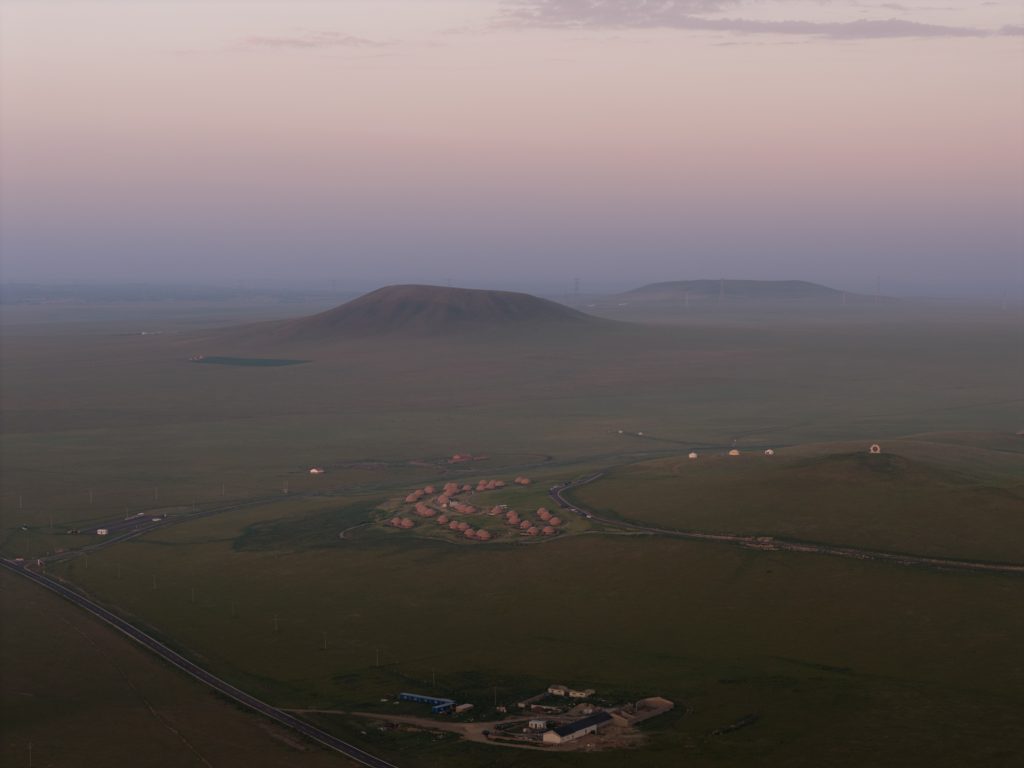
PLAT ASIA designed the Volcano-In Hotel of Arrivals and the visitor center, which was completed in December 2025. The hotel is situated on the south slope of a volcano that erupted during the Quaternary Period, within the Baiyinkulun Steppe & Volcano Tourism Resort. It overlooks the steppe, lake, and sandy land to the south.
DESIGN CONCEPT
Site: Ecological Restoration
The design team and clients observed that the southern area of this volcano, supporting only sparse herb species, contrasted sharply with the lush vegetation surrounding the volcanoes. Collaborating with geologists and local herders, the team investigated the cause. The site has undergone erosion for approximately 150,000 years. The volcanic cone slumped into nine hills, now covered in soft grassland, and blended into the steppe. Located southeast of the cone, the hotel site is leeward to the northwest wind, resulting in snow and sand accumulation. Harsh soil conditions make plant growth difficult. Therefore, the hotel was deliberately sited over two-meter-deep sand pits to prevent their expansion, replace them with a new ecosystem, and restore vitality. Strategies include a snow barrier wall to retain water, protect the soil, and create a better environment for planting.
Cluster: Volcanic Landscape
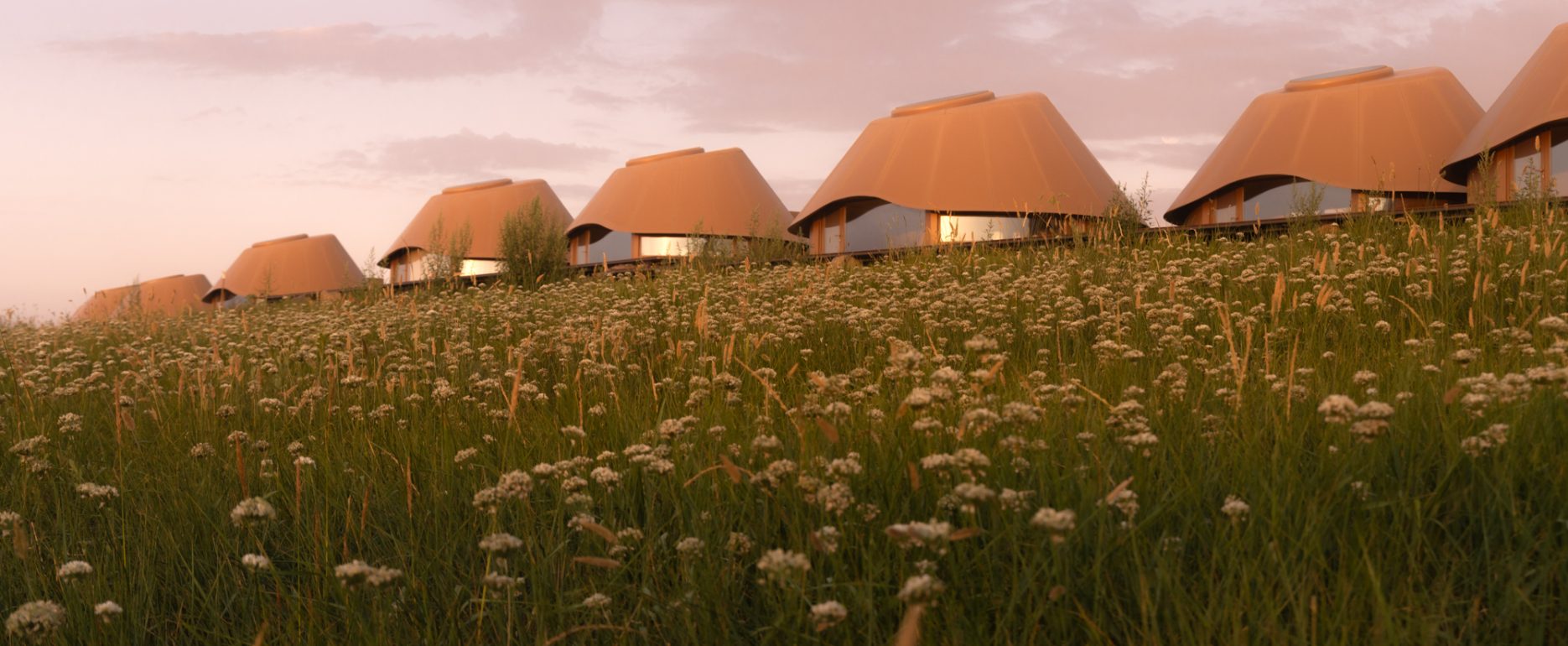
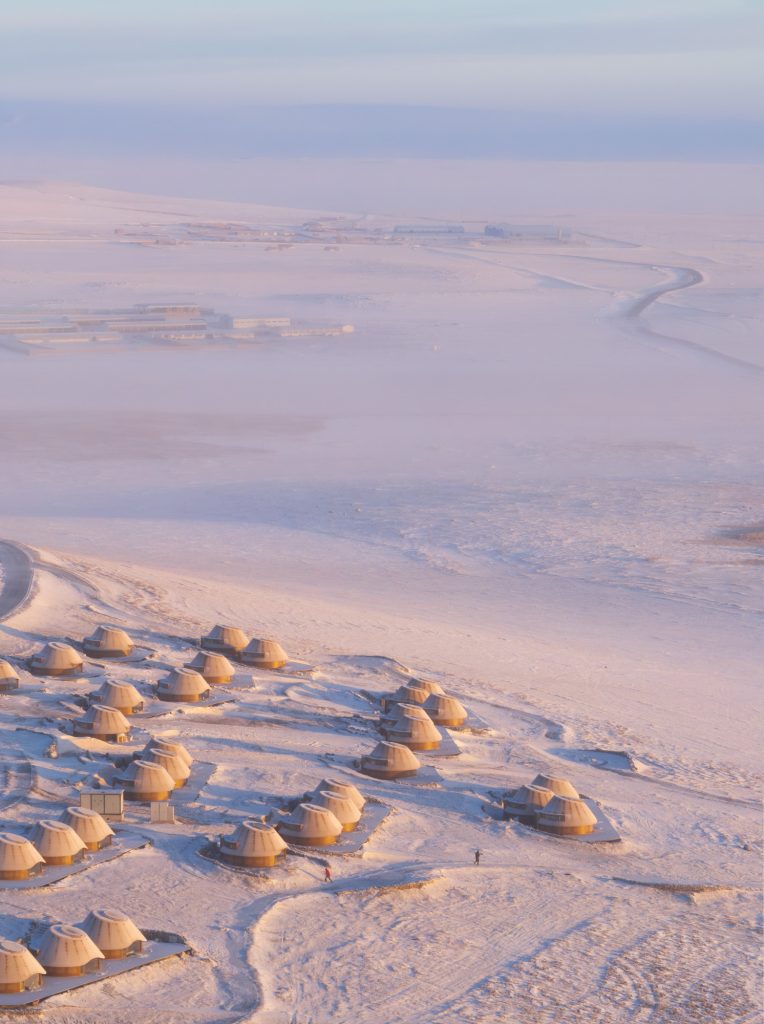
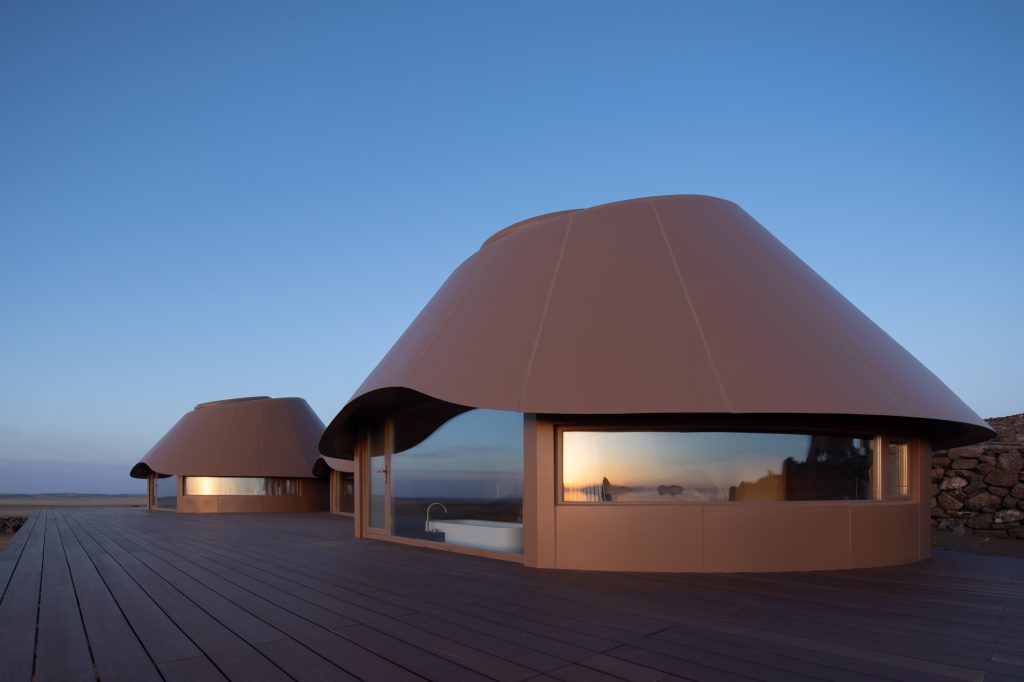
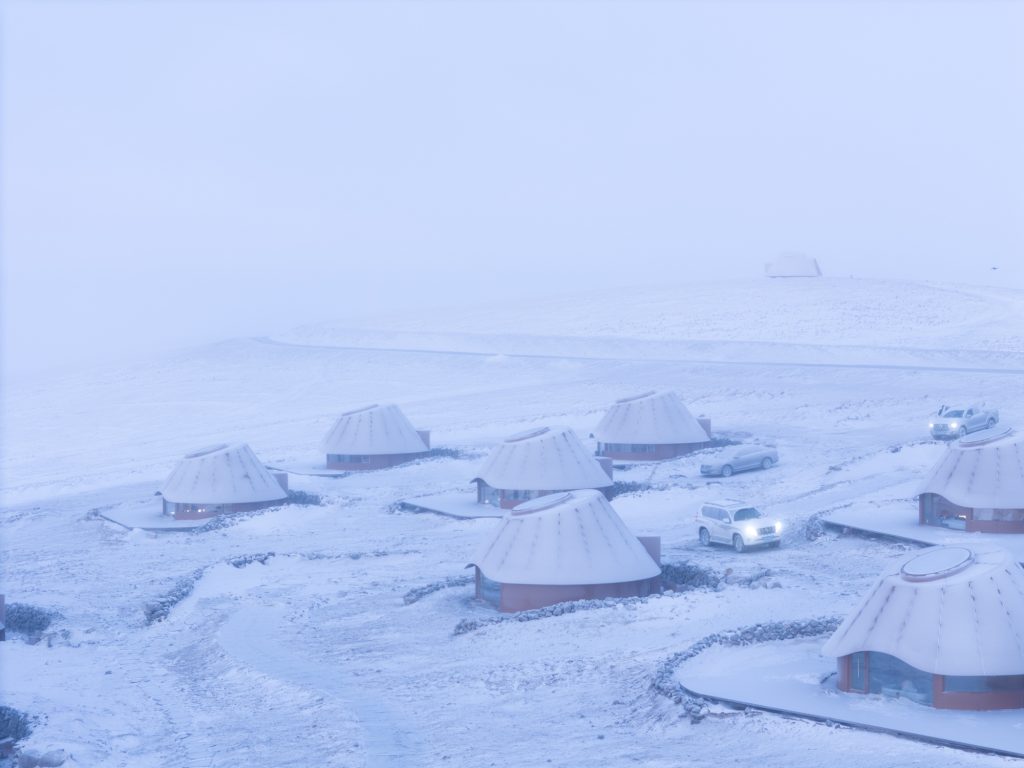
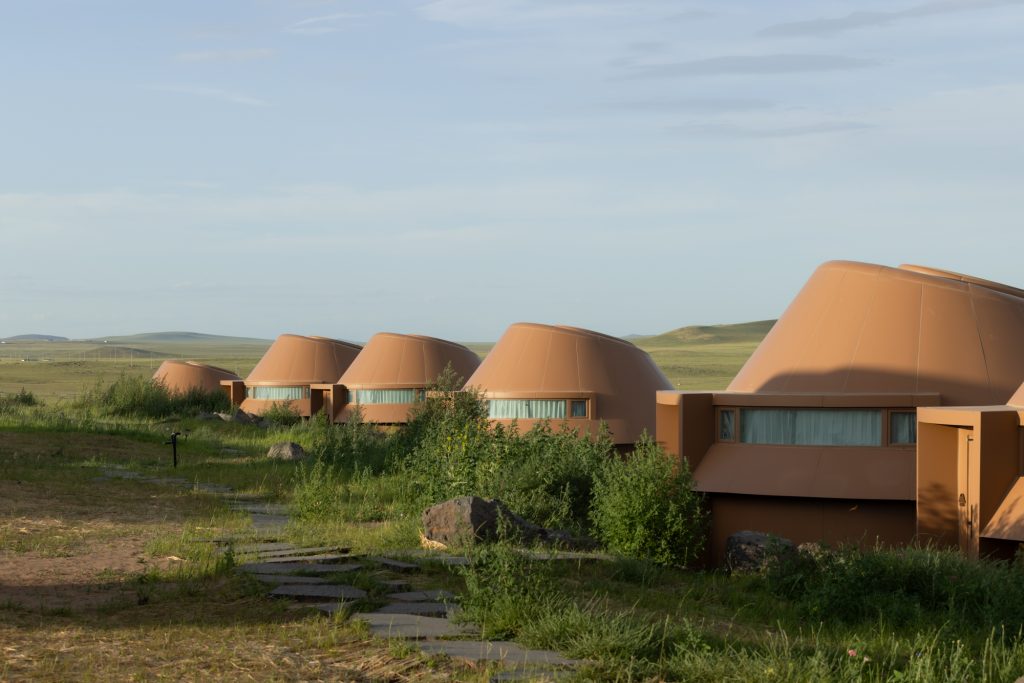
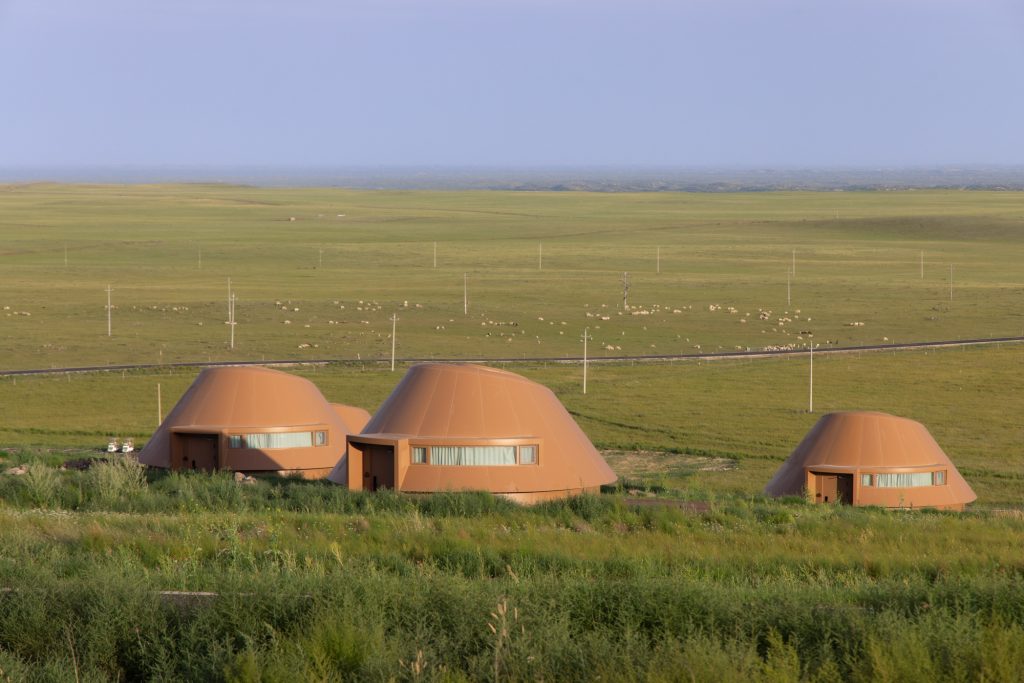
The design of the Hotel of Arrivals is inspired by volcanic eruption patterns. Lava flowing from branch tunnels rapidly forms volcanic cones. Architect Bian Baoyang envisions the hotel as the “Son of Volcano,” comprising a cluster of volcanic forms. As an approach to the volcano, the hotel cluster build a place that connects people to the landscape. Circulation within the hotel zone features a branch-like path paved with volcanic rock. Each hotel unit includes a guest suite, terrace, and snow barrier wall. The layout is carefully arranged so that every unit features a full-view window. Topped with a cone-shaped aluminum veneer roof and encircled by a glass curtain wall, each unit has a russet surface resembling volcanic rock and appears to levitate above the ground. The volcanic rock landscaping integrates the hotel into the volcanic context.
Experience: Cultural Context
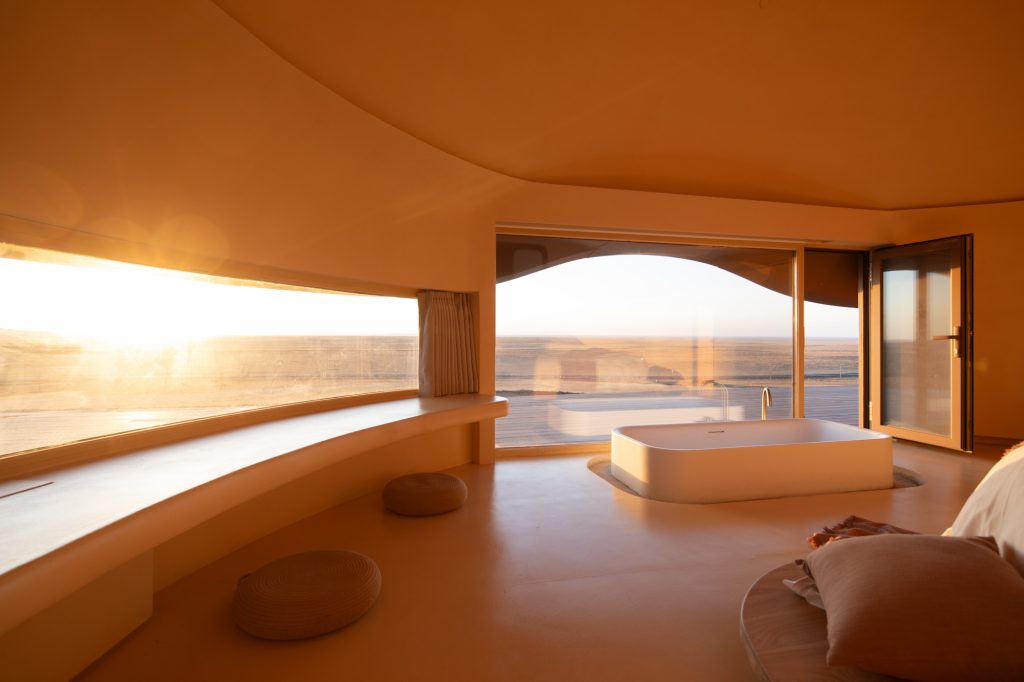
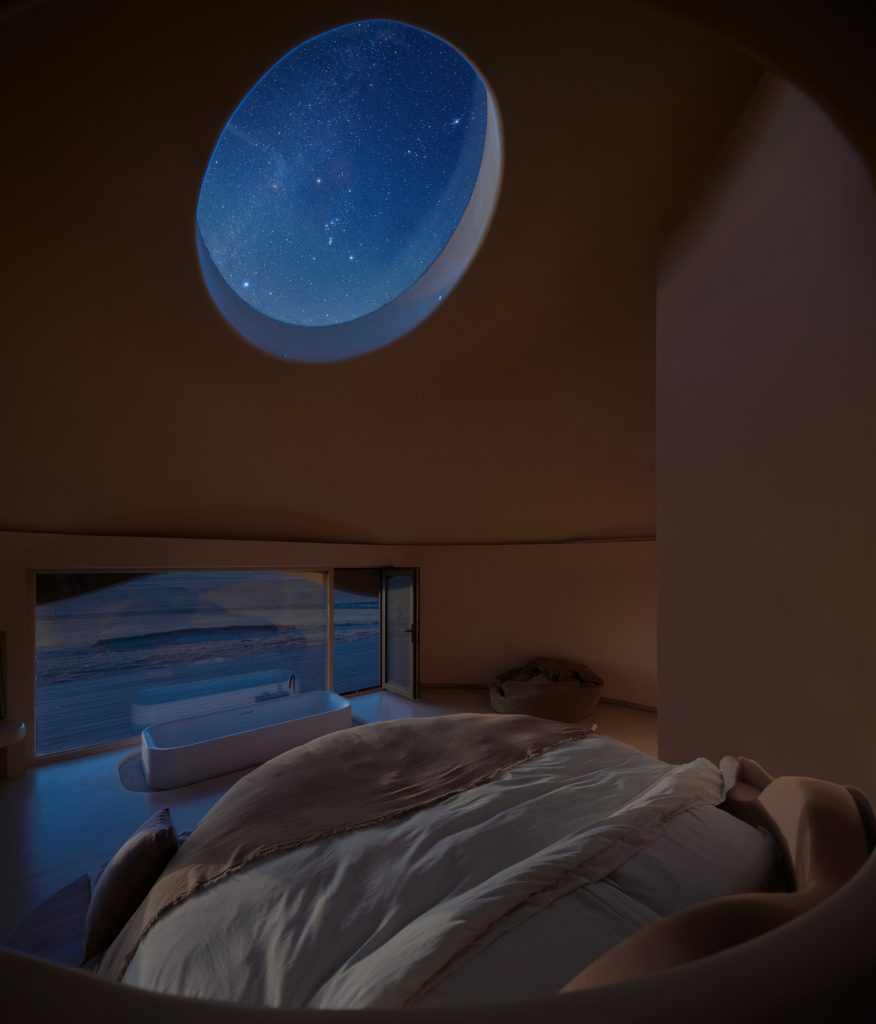
Color tone research is based on Bowen’s Reaction Series, which describes the order of crystallization in cooling lava. The rock displays varied textures and colors that inform the architectural surfaces in russet color and a bright hue called ChiZhang, offering an immersive volcanic crater experience in interiors. Each unit features three window types: an oval skylight, a horizontal scroll window, and a hanging scroll window—their dimensions inspired by traditional Chinese painting. The natural landscape of steppe, lake, sandy land, and sky unfolds in orderly layers within the window frames, offering contemplative views.
The Yingchang City Relics is located about 8 kilometers southeast of the hotel. During the design phase, Architect Bian Baoyang frequently visited this site, once part of the feudal estate of Princess Supreme of Lu, Sengge Ragi, a renowned female collector of the Yuan Dynasty. The princess greatly admired traditional Han nationality culture, often inviting artists and poets to cultural gatherings and curated exhibitions. Among her classic collections is the famous handscroll Poem on the Hall of Wind and Pines by Huang Tingjian. The opening lines, translated by Alfreda Murck, read: Next to a mountain was raised a hall that surveys a level stream, / Late at night, Sieve and Dipper stick between the rafters. This poetic imagery resonates with the experience of lying in the room and gazing at the starry sky through the skylight, where the clear, deep night reveals the Sieve (Winnowing Basket) and Dipper (Big Dipper) asterisms—especially vivid on summer nights and throughout all seasons.
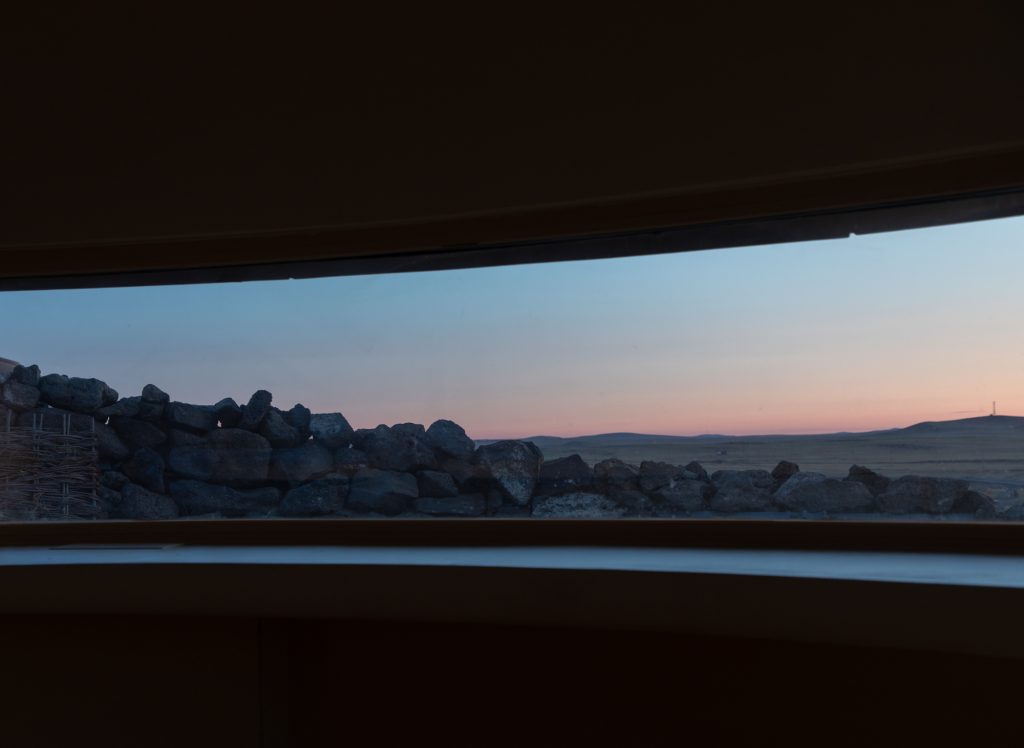
The horizontal scroll window derives from the Chinese handscroll paintings. Based on an analysis of works such as Wang Ximeng’s A Thousand Li of Rivers and Mountains (height 51.5 cm) and Zhan Ziqian’s Stroll About in Spring (height 43 cm), the window is set at a height of 45 centimeters and a length of 3 meters to frame the vista. The curved snow barrier wall even has been a part of the sight at the edge of the pictorial space. The hanging scroll window adopts a typical height of 150 centimeters, seen in works such as Guo Xi’s Early Spring. These windows frame the wild natural landscape, while the curved lines and viewing apertures encourage a reclining or seated posture, fostering a sense of reverence, imagination, and healing that connects people to the land.
Dawn: Light of Civilization
Architect Bian Baoyang conducted extensive research on the Baiyinkulun Steppe and its volcanic context. He regarded it as “a ray of light among Chinese civilization.” Geological, evolutionary, and archaeological studies show that the Hongshan Culture (6500–5000 years ago) is one of China’s earliest prehistoric cultures. As a cradle of Chinese civilization, the crescent moon-shaped culture belt (proposed in 1986 by Tong Enzheng in The Collection of Artefact and Archaeology) originates from the West Liao River, formed by the Xar Moron River—which rises in the Otindag Sandy Land—and the Luu Moron River, originating from the Qilaotu Mount in the Yanshan range. The Baiyinkulun Steppe and Volcano have witnessed this cultural development and greet the light of civilization each dawn, as the sunrise illuminates this vast and flourishing land.
Arrivals: Solitary Vigil
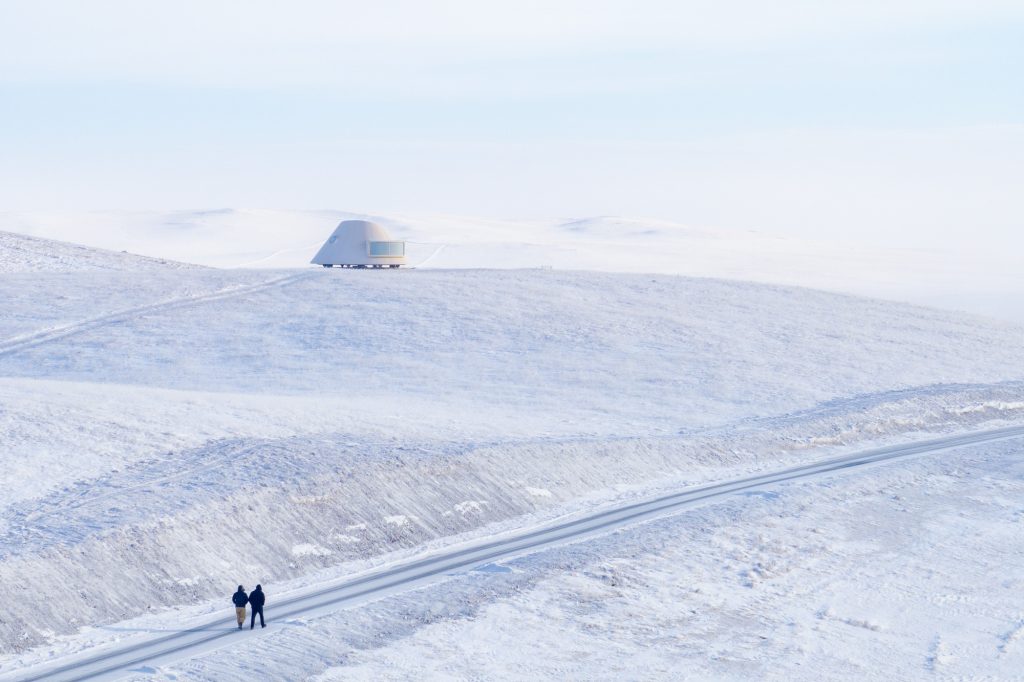
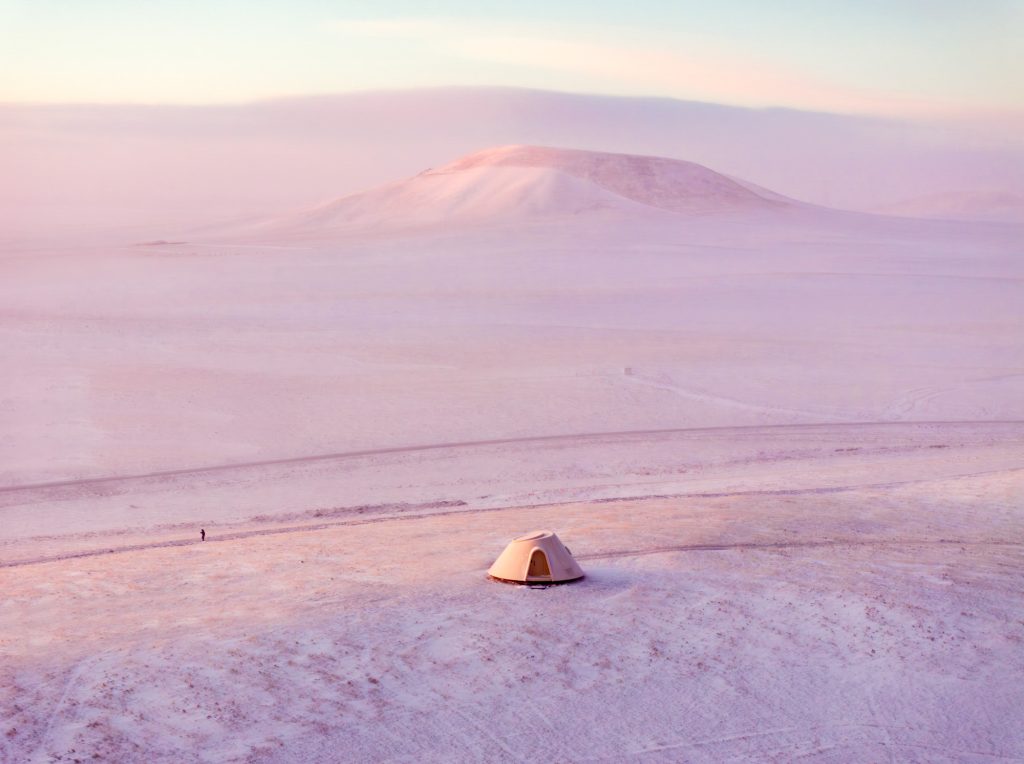
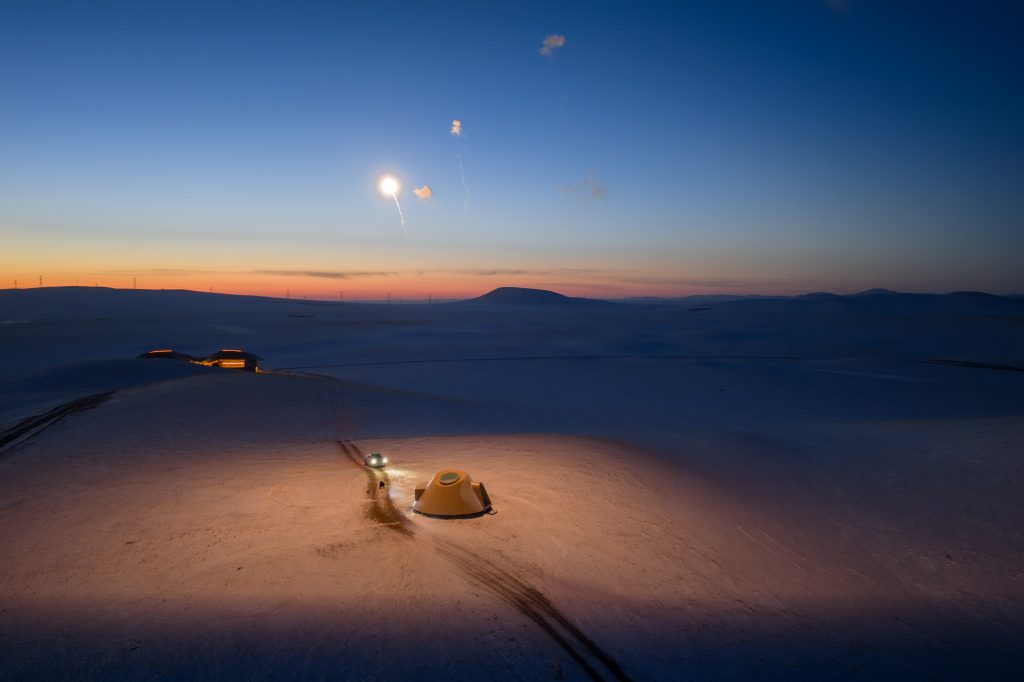
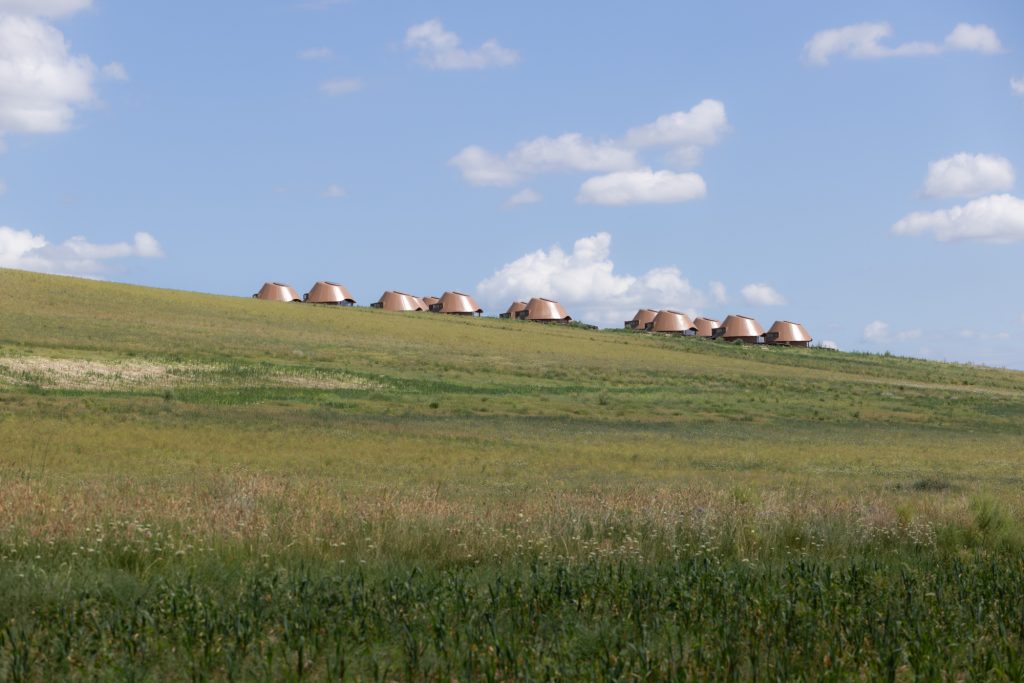
The hotel unit evolved from a tent prototype into a volcano-shaped “Arrival,” with two generations of design. The first generation (Gen One) is a rotating structure. In May 2024, the first Arrival was transported to the site, assembled, and suspended on the north hilltop overlooking the Gen Two cluster. To its east stands the Flame Art Installation of Volcano, and to the northwest, the visitor center. Its pivotal base supports a rotating mechanism, allowing the building to float above the earth and follow the sun for 360-degree views. The Gen Two Arrival retains the volcanic form while expanding the space to include a terrace and courtyard, meeting hospitality needs for function and scale. Looking up at the Gen One Arrival on the hilltop from the Hotel of Arrivals, one senses the solitude of pioneering work—yet it meets the grand vista from the very beginning.
The Volcano-In Hotel of Arrivals aims to restore ecology and environment; its clustered layout responds to the volcanic site with low-impact principles. By engaging with geology, climate, and meteorology, it invites people to experience the wilderness honestly and sensitively in every moment and scene, creating an immersive journey into the volcanic dream.
PROJECT INFORMATION
Architects: PLAT ASIA
Principal architect: Bian Baoyang
Project architect: Ma Xuan, Guo Lulu
Site architect: Su Lede
Architecture & Interior design team: Liu Xinwei, Yang Lu, Dong Zijuan, Chu Jianwei, Zhang Chaowei, Ran Haoyu, Zhang Kaijie
Landscape design team: Zhang Xiaozhan, Wang Xiaochun
Construction design: Beijing Zhongtian Jianzhong Engineering Design Co.,Ltd
Steel structure design and construction: Beijing Jinshengjie Membrane Structure Technology Ltd., Co.
Glass curtain wall and roof construction: TONGCHUANGHUAJIAN Group
Lighting consultant: Beijing Wuse International Lighting
Construction contractor: Inner Mongolia TianLong Construction Co., Ltd.
Clients: Inner Mongolia DA MENG SHEN ZHOU Tourism & Developed Co., Ltd
Operation team: Baiyinkulun Steppe & Volcano Tourism Resort
Photo: Arch-Exist Photography
Video: Nandin@PLAT ASIA
Use: Resort Hotel
Design scope: Architecture, Interior, Landscape, Lighting, Decoration, Signage
Type: New building
Functions: Guestroom Suite (45 suites, PhaseⅠ)
Site area: 5,540sqm
Building area: 1,634sqm
Layers: 1F
Max height: 4.18m
Structure: Steel
Building materials: Aluminium panel, Glass, Volcanic Rock, Micro cement
Plant lists: Clematis florida, Anemoned sylvestris, Bistorta officinalis, Androsace umbellata, Saposhnikovia divaricata, Solanum nigrum, etc.
Design period: 3/2024-12/2024
Construction period(Phase Ⅰ): 6/2024-12/2025
Completed: 12/2025
Opened: 1/2026
PUBLICATIONS
orstyle magazine, Apr 2026, Issue170, Taipei
Architectural Practice magazine, Oct 2025, No.081, Beijing